
An
alternative name for emotion-colour synesthesia is "coloured emotions"
Note: this page is about synesthetic experiences evoked by the synesthete’s own emotions, not those observed in other people. To find out more about this latter type, see the page Perceived emotion-to-colour (and other concurrents).

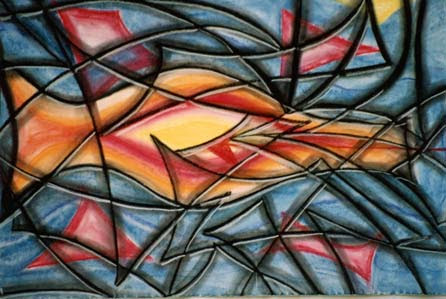
This type of synesthesia consists of having visual experiences of colour (or colour and shape) in response to different emotions. Some synesthetes actually see these visual concurrents physically in front of them (projector synesthetes), while others, the majority, only see them in their mind’s eye (associator synesthetes). They may take the form of a transparent colour field like an overlay, tinting their vision, they may resemble a cloud or mist, or the synesthete may feel that the colour is irradiating out of a particular part of the body, for example. When the colours also have shape it is normally a simple or complex geometrical figure, either single or multiple. In general it is not a very common type: in Sean Day's study on 1,143 synesthetes, 3.24% reported having visual experiences in response to emotions. The colours and/or shapes perceived for each emotion are consistent, and they are also idiosyncratic, varying greatly from person to person. They are not guided by conventional correspondences such as red=anger or passion, grey=seriousness or boredom, although they may occasionally coincide. (A colour semiology chart explaining the traditional connotations symbolised by each colour can be consulted in this interesting article). It is interesting to note that this type is often reported by synesthetes on the autism spectrum, who sometimes say that although they have difficulty in recognising and describing their emotions, they perceive them clearly as having a certain colour scheme, and this can ultimately help them to classify their emotions and better understand their variety and complexity.
Here
are some descriptions written by people with this type of synesthesia:
Emotion-colour
These two people describe perceptions of translucent colours that appear as floating in space or covering objects when a specific emotion is felt:
“When I'm happy I see a blue color floating in the air. It's slightly transparent and usually lasts only for a second or two. I see yellow the same way usually when doing chores or during an endless math lesson. I see magenta when having really negative emotions.”
(Source: This post on the Synesthesia subReddit. 2016.)
“Sometimes when someone hugs me and I feel safe or protected, then everything is covered in a light, translucent cyan. When I’m feeling loved the world is pinker than usual (a very pale pink). When I’m angry it’s a bright but translucent red hue around everything.”
(Source: This post on the Synesthesia subReddit. 2019.)


(Source: This comment and this post/comment on the Synesthesia subReddit. 2022.)
Spanish artist Pepa Salas Vilar perceives that she is constantly surrounded by colours and shapes. If she chooses to focus on them they become very tangible and can be described in great detail. In this example she talks about preparing to travel, which creates an array of different emotions: stress, nerves, the feeling of leaving her home and family behind and the fond farewell. Each of these separate emotions evokes different colours and shapes.
“The journey…. the journey always stresses me out, and stress appears to me as a deluge of little watery red spheres like caviar that crash into me and explode one by one. My emotions grow as I pack my suitcase. The idea of departure starts as carmine red, and when the time actually comes it has turned into an opaque, amorphous white goodbye. The feeling of saying goodbye is a whitish-grey mist that engulfs me, expanding all around me until it touches the rest of my family.”
(Source: Pepa Salas Vilar, cited in the book “Sinestesia. El color de las palabras, el sabor de la música, el lugar del tiempo…” by Alicia Callejas and Juan Lupiáñez, pub. Alianza Editorial 2012. Original in Spanish.)

Here is another example of how colour and shape perceptions can form a normal, conscious part of an emotion-to-colour synesthete’s surrounding environment:
“I have something like hallucination since my first memory. It's colorful bubbles in the air. … The size, color, shape and movement of the bubbles change according to my mood. For example, when I feel happy, the bubbles are small, yellow and move upward in the air. When I'm angry, the bubbles move faster from left to right.”
(Source: This post on the Synesthesia subReddit. 2019.)
Emotion-colour synesthesia can have differing degrees of intensity: it can be practically unnoticeable, it can form a conscious part of everyday life (as in the previous two examples) or it can feel intense and powerful, when the emotions are also strong. The description that follows is about an extreme situation and how it affected the strength of the synesthetic perceptions:
“As my emotions get stronger, so do the visions I see in my mind. This is especially true for negative emotions, for example extreme fear. For example, in one instance, I have suffered severe panic attack because of the fear I was facing. All I could see were these glowing white branches that were gently growing into beautiful shapes, and it was as vivid as real life. It did not help me calm down tho lol. On the other hand, sadness looks like metallic-grey fog. Happiness is like cubes, spheres and pyramids coated in vaporwave shade of purple.”
(Source: This post on the Synesthesia subReddit. 2019.)
Emotion-texture
It is also possible for emotions to be consistently and consciously associated with a particular texture, which can be visualised or felt as a perception. Although the texture may form part of a colour concurrent, some synesthetes may feel it as just texture alone, without any inherent colour at all:
“When I have certain emotions I start getting flashes of textures. Especially when I am anxious, in my head a rough leathery texture to smooth peach texture keeps flashing. (…)
The texture isn’t something I am feeling on my skin, or just visually in my head, it's almost as if I am a part of it.
[Excitement] feels like the hairy tingling you get when you almost touch something staticky. [Depression] feels like hard clay.”
(Source: This post/comment on the Synesthesia subReddit. 2023.)
For the case of actual tactile sensations being felt in the body or on the skin, with or without a specific textural component, see the page on Emotion-tactile synesthesia.
Emotion-image: could it be considered synesthesia too?
In a few cases, figurative images are pictured in response
to emotions, with feelings being consistently perceived as objects, scenes,
places or
people. This might be simply an associative process, or there could perhaps be
a case for considering it a variant of emotion-to-shape synesthesia. Here is an example:
"My emotions are physical things. Like anxiety is a knotted hollow tube. Joy is like a belt around my lower back, and so forth. They’re real to me, but when I asked others if they experience this, they say no."
(Source: This post on the Synesthesia subReddit. 2020.)
This next description could even be connected with the phenomenon
of personification, as the concurrents take the form of specific people.
However, this case does seem to have key differences from synesthetic personification,
as it seems to be exclusively visual rather than taking the form of in-depth
perceptions of human characteristics like personality, social status, hobbies, tastes or relationships
with others. As visual synesthetic concurrents tend to be abstract – colours,
shapes, textures – and not pictorial, it might be more logical to consider these
particular pairings strong, consistent associations rather than synesthesia.
If personality is perceived, it may of course be a variant involving
personification of the emotions, similar to ordinal linguistic personification.
In case of doubt, it is always interesting to know if
the person who perceives the images has other types of synesthesia, as in a non-synesthete
it would be much more likely that perceptions of this type are merely ingrained
associations.
In this specific case, it appears that the person does
not have any other types of synesthesia. Even so, the description is interesting,
evocative and rather mysterious:
“For as long as I remember, when I feel certain emotions strongly or think back on a memory where I felt such an emotion strongly, I picture a character at the same time.
For example, excitement is a dark-skinned young woman,
frizzy hair, dyed a pastel rainbow at the bottom, wearing a purple tank top and
black denim shorts, with a unicorn horn headband. Anger is a young pale-skinned
man with fawn brown hair, wearing a red flannel shirt. His body cuts off at the
torso and has no arms, and he has floating purple hands.”
(Source: This post on the Synesthesia subReddit. 2020.)
Related types of synesthesia:
Emotion-smell and emotion-taste
Perceived emotion-to-colour (and other concurrents)
More cases / readers' comments: read all the comments on
this article here
(See the latest comments, received in 2026, below. Or follow the above link for access to all the reader comments
describing their own experiences: it makes interesting reading)
This page last updated: 12 May 2026

Can i ask if emotion-image synesthesia *has* to be consistent images? Like NOTHING changed at all? Because emotion-image synesthesia sounds all too familiar but when i saw that apparently the images need to be consistent i said “oh…” to myself. The thing is, its not that the images change 24/7 but im more saying that multiple images that are continuous if i feel that certain emotion come up. Honestly the only thing that has the same image in my head is anxiety, stress, spiraling, etc. But if im happy my mind has many ways to make a figurative image/scene/sounds in my head. I could say the patterns/principles of those images are the same but the themes/whats in the images or scenes can be very different. I guess it also matters that the happiness can be expressed in different ways like “fluffiness” and such, but thats my question!
ReplyDeleteHi! Sorry about the delay in replying - there were some comments I didn't see at the start of the year and I'm just finding them now.
DeleteFrom what you say, I think that what you are perceiving with emotions could be considered synesthesia, yes, because you say that some of the more basic ones are definitely always the same while others might have different images but the same patterns or principles repeat. Also, as you say yourself, giving the example of happiness, an emotion that has one name might actually be several or many different types of specific emotions, which your mind would differentiate between (even if you don't do it consciously), all under the same umbrella term. So I would consider this synesthesia. Especially if you have other types as well, in which case it's clear you're a synesthete.
Some of what you say (a pattern or principle appearing as an image in response to a certain feeling, even if you haven't perceived that exact image before) reminds me of "one-shot synesthesia", so you might be interested in reading about that and see if you feel identified. There's a description and some examples of it here on the Tree, on this page: https://www.thesynesthesiatree.com/2021/02/concept-shape-synesthesia.html (look for it about halfway down the page if you can't find it straight away!)
Hi there, I have a question about a type of synesthesia I think I might have. I suspect it's a form of 'Aura Synesthesia' mixed with 'Emotion-Color' synesthesia. I see translucent color mists around people. I don't know what exactly triggers it, but it happens spontaneously, and I'm sure that it's related to the intense emotions those people are experiencing at that exact moment.
DeleteFor example, once my literature teacher was furious and angry at our class during a speech performance, and I saw a CLEARLY observable, LARGE yellow mist surrounding him. It moved whenever he moved, basically surrounding his body. The opacity and size of these mists seem to change according to the intensity of the person's feelings at that time. Like, right after my literature teacher's angry speech, a girl in our class named Burcu went up to make her speech. I saw a green mist surrounding her, but it was mid-observable and medium-sized because she was calm, but not THAT calm. Also, there was this one time our biology teacher was angry with us. As you can guess, he was surrounded by yellow, just like the angry literature teacher. However, our biology teacher is quite cold-blooded and hides his emotions 90% of the time, and I could tell he was actively trying to suppress his anger. Interestingly, while the main mist was yellow, there was a very thin, barely visible red outline deep within the yellow, right next to his skin.
I’ve had these visions since the 7th grade, but back then I didn't really care about (i used to do researchs about it but only thing i could find back then was just parapsychological aura thing) it that much. I used to tell my friends, and they'd mock me saying, 'Do you think you have a chosen energy or some s***?' But now, I feel like I need to look into this more deeply. Basically, the colors I see most frequently are yellow and green—yellow for furious or angry individuals, and green for those who are calm.
What are you all thoughts?
I looked a little more and the closest type to what i have looks like "Perceived emotion-to-colour". Is that true?
DeleteYes, you're totally right, perceived emotion-to-colour is what you're describing here, and such a clear and classic case, I love your description. You're also right in saying it's like emotion-colour mixed with aura synesthesia, as it has components of both, although perceived emotion to colour is the exact type. I like how you've been able to analyse the effect of aspects like the intensity of the emotion (determining the size of the photism and also its opacity) and the actual emotion itself (determining the colour). That's very interesting about the red outline inside the yellow perception around your biology teacher, who is the type of person who hides his emotions... what do you think the red part meant in this case? Was it his struggle not to show his anger? An underlying coldness? Or do you not really know (that can often be the case unless you analyse it, as the colours appear spontaneously and just "are what they are" and we often need to think about what they mean... They are extremely intuitive, appearing before we have any words to describe what we're perceiving in other people). Do feel free to ask any more questions about this, I think it's such an interesting subject and your case seems very clear-cut!
DeleteThanks for answering :) I don't exactly know what the red color is but i guess it is related to hiding some emotions, because until that time i only saw normal yellows and greens and those people were clearly having those emotions but my biology teacher was trying to hide it, you could tell it by his eyes though Also, the red color line was in the yellow mist but it was very close to his body and it was barely visible, so i think it makes sense. I have a couple questions: Since now, i've only had these experiences more than 10 but less than 16 times, (i just guess the numbers because i dont exactly remember, but basically it happens pretty rare). Why is it that rare, is there any way that i can exercise this and make it more common? Also, is there a way i can find what triggers it? I'd love to make it happen more common so i could experience it more and realize more about it.
DeleteI think you only see the colours sometimes because your perceived emotion-to-colour synesthesia is not immensely strong: normally it’s just kind of there in the background and you don’t even notice it. Some people have this type of synesthesia very strongly and live their lives constantly surrounded by other people’s colours, but not all of them of course. And for those people it can be overwhelming anyway and certainly not ideal. I personally think having a milder version is much better.
DeleteProbably in your case the colours appear to you when you get a particularly powerful impression of someone’s feelings for whatever reason, or it can also happen to you if you’re particularly sensitive one day, or overtired, or especially relaxed, or for specific reasons like that. Yes, you can focus on it to become more aware of it and will probably become stronger if you do. Just enjoy looking at people’s colours whenever you get a chance to quietly observe them and their interactions. I think you have to seek out the moments when you can do that. When you’re involved in a conversation or social interaction with them yourself, it can be difficult to stand back and do this, as you’re concentrating on other things and what they (or you) are saying, so I think colours don’t often appear because of that focus on other things.
It’s interesting you mentioned that some of your stronger appearances of this phenomenon happen with teachers at school (and your classmate Burcu who got up to give a presentation), because that is the ideal situation for visible colours, the situation where you’re just watching as a spectator and don’t have to concentrate on interacting yourself or thinking about what you’re going to say.
Yes, that is what i've been thinking about. Most of the experiences were happening while i was in the class so that probably has something to do with that situation of not being have to concentrate on things etc. But that doesn't sound like that is all because i think if it was only that i'd have had these experiences with my friends too, i do recognize their feelings even if its intense or not but i never have seen colors around them. Maybe the only trigger isn't emotions?
DeleteYes, it could be due to some other factor or factors too.
DeleteIt could be that you get a colour perception for certain types of emotion only and not others.
It could be connected with HOW the person in question expresses the emotion. Perhaps it needs to be a subtle expression for your intuition to be sparked off (if it's too obvious it wouldn't be relevant or necessary for you to get a colour), or on the contrary they might need to express it with more visible signs. Or express it in certain ways, which you could perhaps ascertain by analysing what kind of expression of emotions triggers it for you and what kind doesn't.
Perhaps it only happens with people you don't know very well.
Perhaps it only happens in situations where you feel that the person is in "authority" in some way (a teacher or someone who is going to give a talk to the class in this case). (The reason could be quite specific.)
Perhaps it only happens when the emotion felt poses some kind of threat to you or it's especially useful to intuitively know about it because that would help you in some way.
Perhaps it only happens with complex emotions or emotions you have difficulty in understanding exactly or figuring out.
I do think the trigger is the emotions and not something else (if you're not also getting auras for personalities or consistent colours for people in general that you know or are in the process of getting to know). But, as I've mentioned, perhaps it's only CERTAIN emotions, or HOW the person is expressing those emotions exactly, or how you yourself are perceiving those emotions at that time.
I think you could find out what it depends on. It would be an interesting idea to think about or note down when it's happened - what the emotion, the person, your relationship with them and the situation were and whether there was anything special about the moment you felt it at (if you were in a situation of tiredness, awareness, sensitivity, emotivity, tension, stress, nerves, etc.) - and see if you can find a pattern. I'm sure you will eventually because it is sure to depend on something!
You are right. I will try to exercise it and explore it more. Thank you so much for your help :))
Delete